Navigate using the words Our glory and fame
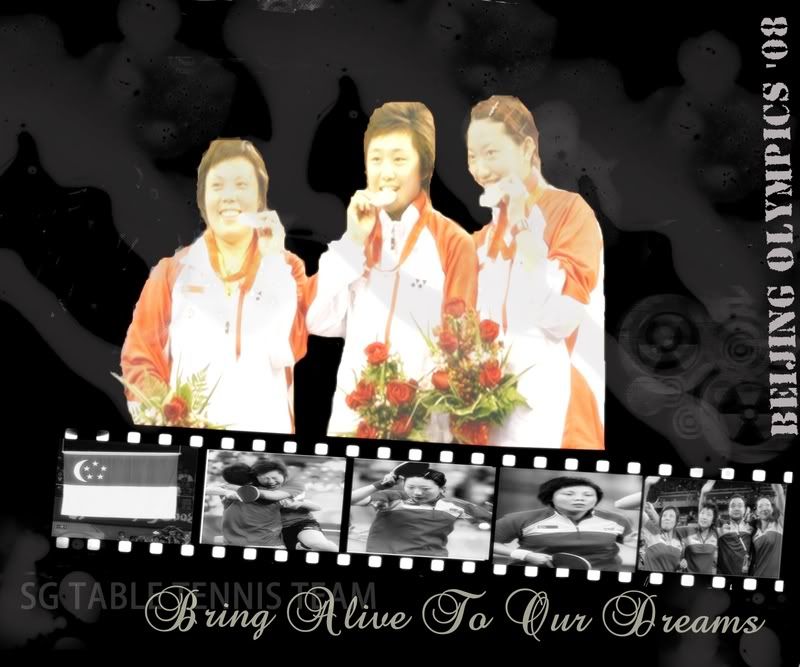
We are proud, the silver with honours.
[#1] Do not RIPP anything off!
[#2] What's here belongs here!
[#3] Tag Before you Leave Please!! =D
[#4] N0 Vulgarities please!
[#5] Strictly NO Spamming!
Your footprints on MF girls' team blog
It's you ; It's us !

Mayflower Secondary School
Table Tennis girl's team!!!
Physical Training: Every Thurs 5:45pm (GIRLS)
Trainings: TUES, THURS & Fri(Optional)
Coach: Mr Lim Wei Zong .
Teacher-in-charge: Ms Wynn Chew
Fairy Godmother! Please grant us our wishes!
More Table tennis trainings!
More Table tennis gatherings!
B div girls to clinch the 4th position in national , our zone
C div girls to clinch the 3rd position in national , our zone
Spread the loves!
Loves playing table tennis!!
Love hanging out together!!
The Sufferings.. ARGHH!!
Our pathetic 5 mins break
No table tennis trainings
The tiring physical trainings

Saturday, August 11, 2007
( 1:32 AM )
Wednesday, August 8, 2007
( 5:52 AM )
Service Strategies in Table Tennis
In table tennis, the person serving the ball usually has a slight advantage, thus it is important to attack your opponent with your service. You can apply different spins when you serve to gain your advantage. Likewise, if you are on the receiving end, you need to buffer your opponent's attack to try to regain the advantage. Watching the spin of the ball will allow you to return the ball effectively. The strategy is to keep your opponent off-balance with your serves and returns.
Some questions you may ask:
- What are advantages of the different types of table tennis serves?
- How do you return such serves?
- What strategies should be used?
Serving the ball
Your service can be hard and fast, or you can change the pace and fool the opponent with an off-speed serve. Most newer players use a flat service that has little intentional spin. Better players will put a spin on the ball that will not only cause the ball to curve, but it will affect the way it bounces off the table and especially how it comes off the paddle after being hit.
Different service spins include top-spin, side-spin, back-spin and no-spin.
Top-spin serve
In the top-spin serve, you slide your paddle over the top of the ball as you hit it. When hit properly and with force, the ball will actually curve downward in its flight and then skip forward after it hits the table. They work the best when the ball hits near the end of the table on the opponent's side.
Often the server will throw his whole body into the serve, telegraphing the type of serve to the opponent.
Side-spin serve
In a side-spin serve, you bring the paddle across your body to create the spin. With a right-handed server, the spin is clockwise when viewed from above for forehand serve. A backhand serve will create a counter-clockwise spin.
If the opponent hits the ball flat--without a spin--it will go off at an angle to the right for a right-handed forehand side-spin serve and to an angle to the left for a backhand side-spin serve.
Hitting the forehand spin serve to the right side of the table will increase the chances that he will miss the table on his return. Likewise, the backhand spin serve should be served to the left side of the opponent.
Back-spin serve
A back-spin serve is also called an under-spin serve. This serve is very useful against attacking players and against less experienced ones as well. A very heavy backspin has great chances of becoming a lost point by the opponent. It is also very difficult to attack these serves.
No-spin serveNo-Spin serves can confuse and opponent, when used after a couple of spin serves. Also a very fast, long, no-spin serve can be useful when your adversary is too far from a certain side of the table.
Returning the serve
Returning the opponent's serve is quite important, as a good reception can throw him off balance. A poor return can seriously damage your chances to win the point.
What is considered a good return is one that will allow you to attack the next ball. Since good players are hitting the ball faster and with tricky spins, effectively returning the service is becoming quite difficult.
Top-spin serves
Top-spin serves can be difficult to return if they are very fast and long, which happens most of the time. You should be careful and not be caught off balance. You should close the angle of your racket or paddle, facing down, as you should do to any top-spin ball. Try to return the ball as low and fast as possible. Another choice is to try to attack the ball right away, if it is slow and/or high.
Side-spin serves
Side-spin serves are very difficult to return. You should always watch your opponent's paddle contact with the ball to understand what sort of side-spin he uses. Then you can compensate by aiming the paddle a bit to the left (if he did right side spin) or to the right (if he did left side spin). The nightmare of all players is not knowing what kind of side spin the ball has. In those cases, aim to the middle of the table.
Back-spin or under-spin serves
Back-spin serves are very common. The ball tends to slow up or skid when it hits the table. You should open your racket angle, facing up, as you should do to any under-spin ball. Return it with the same back-spin to the opponent, the lower the better.
No-spin serves
You may think that no-spin balls would be easy to return, but it is easily possible to confuse these services with any of the others above. The most important thing is to pay close attention on your opponent's serve to understand what kind of spin he gave the ball.
Strategies to use
You want to vary your serves, but yet concentrate on your opponent's weaknesses. You can learn the weak points from carefully observing his play. Likewise, you must be observant in watching how the ball is served to you in order to compensate for the spin and provide a good return.
A table tennis player can serve the ball with a top-spin, side-spin, back-spin or no spin at all. Returning such serves requires a player to carefully observe how the ball was served. Playing to your opponent's weaknesses in returning serves is a good strategy to use.
Saturday, August 4, 2007
( 10:24 PM )
Table Tennis-(humourous)
a) Stretch: To avoid pulled muscles.
b) Breathe: Not breathing can cause you to die.
c) Wear Comfortable Clothing: Loose clothing may snag, whilst tight clothing may restrict you - and if you don't look good you can't play well.
Well now that you know how to play safe, you'll probably want to play to win. To achieve this one needs mastery of technique, an unimpeded flow of life essence, and strict deterrents for the regiment.
a) Wake at 4:00am every day.
b) Eat a bowl of wheat stalks and small pebbles.
c) Work is then comprised of ploughing the soil, catching flying pigs, and four to six hours of stroke-work and match-play.
d) In the evening, poetry and ellecution.
Extreme players have never eaten ice-cream or interacted with the opposite sex - they're pure. With this technique, you too can be a champion.Remember; play well, play safe, and relent not lest ye be trampled and left for dead.
A guide on playing safe, and playing to win.( Dont take it seriously)
Affiliates
A window to the past
August 2007 June 2008 August 2008 June 2009 July 2009 August 2009 September 2009 December 2009 February 2010
credits